



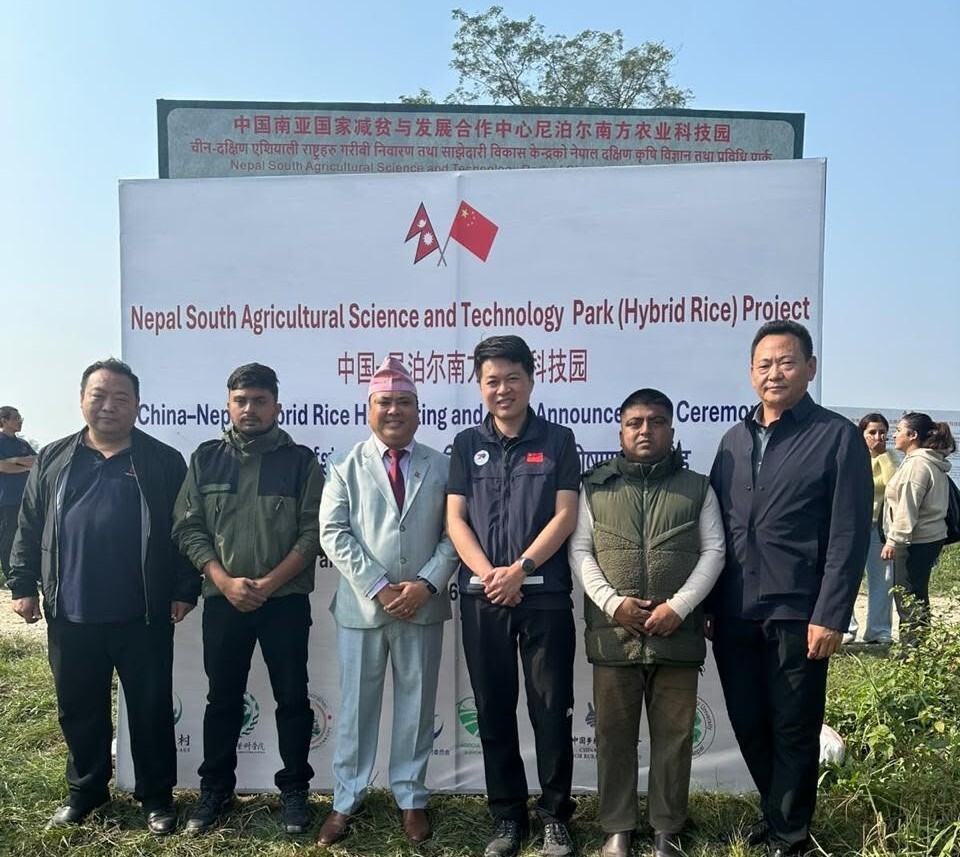

Kathmandu: A Chinese agricultural delegation and representatives of Agriculture and Forestry University (AFU) participated in the China–Nepal Hybrid Rice Demonstration Plot Harvesting Ceremony on November 25 at the Southern Agricultural Science and Technology Park, AFU, Chitwan, marking an important milestone in ongoing agricultural technology cooperation between China and Nepal.
The ceremony brought together representatives of the Chinese Embassy in Nepal, the Chinese agricultural delegation, Chongqing agricultural experts, AFU officials, representatives of the China Foundation for Rural Development (CFRD), project team members, and other stakeholders to review the progress of hybrid rice research and field demonstrations and explore opportunities for expanded agricultural cooperation.
During the inaugural ceremony, Prof. Rishi Ram Kattel, PhD, Vice Chancellor of Agriculture and Forestry University, welcomed the Chinese delegation and highlighted the progress and achievements made through the university’s collaboration with Chinese partners. He emphasized the importance of technical cooperation, knowledge exchange, and joint research in introducing and evaluating improved hybrid rice varieties under Nepal’s agro-ecological conditions. He also acknowledged the project’s contribution to strengthening the university’s agricultural research and demonstration capacity.
Similarly, Mr. Tan Ping, leader of the Chinese delegation, highlighted the achievements of the cooperation initiative and emphasized the importance of sustained agricultural technology collaboration between China and Nepal. He underscored the value of continued cooperation in hybrid rice research, technology transfer, and knowledge sharing, reaffirming the commitment to strengthening agricultural collaboration as part of the broader China–Nepal friendship and partnership.
A representative of the Rastriya Swatantra Party (RSP), also addressed the ceremony, highlighting the importance of agricultural modernization, improved production technologies, and international cooperation in advancing Nepal’s agricultural development. He noted the potential of hybrid rice technology to contribute to increased agricultural productivity and strengthened food security.
Following the inaugural ceremony, the Chinese delegation, together with the AFU Vice Chancellor, university representatives, agricultural experts, CFRD Nepal country Director Ms. Zou along with project team participated in the harvesting activities at the demonstration site. The participants also visited the demonstration plots to observe crop performance and assess the growth and development of the introduced hybrid rice varieties under local agro-ecological conditions. The field visit provided an opportunity to review the practical results of the demonstration and exchange technical observations on hybrid rice production.
The Chinese delegation, together with the AFU Vice Chancellor, university representatives, and project team members, held a technical meeting to review overall project implementation, research progress, and key achievements. The delegation also learned about the university’s laboratory facilities, hybrid rice production and varietal research, demonstration plots, expert resources, and training infrastructure. The discussions focused on hybrid rice demonstration results, research findings, technical progress, and opportunities to further strengthen institutional collaboration. The participants also explored opportunities to expand hybrid rice research and initiate further technical cooperation in rapeseed production.
The China–Nepal agricultural technology cooperation initiative aims to strengthen agricultural research, introduce improved production technologies, and enhance the technical capacities of local institutions and farmers through practical demonstrations, expert collaboration, and knowledge exchange. The initiative provides a platform for Chinese and Nepali agricultural experts to share technical expertise and explore context-appropriate approaches to improving agricultural productivity.
The harvesting ceremony and technical discussions further reinforced the commitment of both sides to expanding cooperation in hybrid rice research, exploring rapeseed development, strengthening institutional exchanges, and promoting agricultural technology transfer. These efforts are expected to contribute to sustainable agricultural development, improved production capacity, and enhanced food security in Nepal.










प्रतिक्रिया